[threecol_two]
 A Freedom Ride With Young Abe
by Aileen Jacobson
“HOWDY” is about as friendly an opening line as a musical can get. Along with some twangy guitar music and the broad, easy smiles of an energetic cast, it heralds the start of a bright new musical.
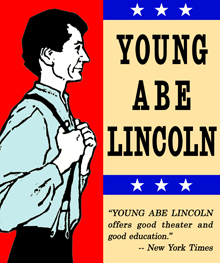
“Young Abe Lincoln” is aimed at children 8 and older, but adults will enjoy sitting through this hour, too. It’s one of Theaterworks/USA’s best shows ever, a brisk and tuneful look at our 16th president during his early 20s. It has the added distinction of being a play about freedom that’s being offered free.
We first meet young Abe speaking out against a slave sale in New Orleans, then pick up his story in 1830, as he moves from Indiana to Illinois with his parents. He’s 21 but has no idea what he wants to do with his life, except that he doesn’t want to become a farmer like his father. He can read and write, which sets him apart from most people he knows; he’s considered well-educated because he’s had a year of schooling, off and on. He’ll walk miles to get a book. Later, the one law book he’s read qualifies him as the best person available to defend a teacher who may lose her job.
Fortunately he wins the case. He had been on the verge of going home to his parents, after suffering a crushing series of losses: his first election, his job and a woman he loved, who died suddenly.
Playwright John Allen – who wrote another “Young Abe Lincoln” that launched Theaterworks in 1961 – has streamlined the story, seamlessly blending the personal and the public. The show is slightly reminiscent of “1776,” another successful musical about the humans behind history.
Allen shapes the emotional ups and downs so we get joy and sorrow, a hint of romance (scholars are divided over whether Lincoln and Ann Rutledge, who died, were courting or good friends) and a hopeful ending, in which Abe finally finds his calling in the law.
A catchy song about being “on our way,” first introduced on the family wagon ride to Illinois, becomes the musical’s signature, marking Abe’s various rites of passage. Jeffrey Lodin‘s country-style music, which includes a knee-slapping welcome by the citizens of New Salem, Ill., and even dares a couple of ballads (rare in children’s theater), matches the snappy storytelling and director Ted Pappas’ zippy staging.
Even Lincoln’s campaign speeches are transformed into a lively number as the actors race around changing hats and locations to represent people of different towns. Stefan Lingenfelter makes an appealing young Abe (too handsome, but he’s lanky and has a good voice), while the others – Tony Freeman, Eugene Key, Rob Roznowski and Laura Stanczyk – do wonders in multiple roles. Martha Bromelmeier’s costumes lend colorful touches.
With only five actors, it’s understandable that we don’t glimpse siblings, nor does the play clutter its themes by mentioning that Ma is actually a beloved stepmother. In several scenes Abe is shown as unalterably against slavery – which he may have been at the time, before the realities of politics set in. At certain times Lincoln advocated keeping slavery in the southern states to preserve the Union and wrote in 1837 that, though slavery is unjust, “the promulgation of abolition doctrines tends rather to increase than to abate its evils” (an interesting background to Supreme Court nominee Ruth Bader Ginsburg’s view that pushing pro-choice legislation too fast produces backlash.) The play also makes a case for Lincoln as an early feminist, which is certainly a surprise.
[/threecol_two] [threecol_one_last]

[button link=”https://miracleor2.com/product/young-abe-lincoln/”]Request Perusal[/button]
[button link=”https://miracleor2.com/licensing-form/”]Licensing Form[/button]
click the logos below for more
Press & Reviews
[/threecol_one_last]